Data as a service (DaaS) is a business model where data is made available on demand and regardless of the consumer’s location or infrastructure. To enable DaaS, organizations provide cloud-based software for analyzing and managing the accessed data.
What is data as a service (DaaS)?
Data as a Service, DaaS, is considered one of the emerging cloud types. DaaS is hosted in the cloud and provides its data services as Software as a Service to the consumers. Consuming DaaS is a strategic investment for consolidating and organizing your enterprise data in one place, then making it available to serve new and existing digital initiatives.
Challenges of legacy systems vs DaaS
The keys to success in the digital age are how quickly you can build innovative applications, scale them, and gain insights from the data they generate—but legacy systems hold you back.
Let’s take a look at some of the challenges that legacy systems bring.
Lack of agility
Legacy systems are burdened by outdated technologies and complex codebases. They are hard to maintain, update, and extend, limited by their own implementation. For example, legacy systems are often built on the assumption that the data is stored in a relational database, limiting the flexibility of the data model and making schema migrations a nightmare.
Data locked in silos
Data silos are compartments of data that are isolated from other parts of the organization. They limit the ability to share data across teams and applications, slowing down the development process. Additionally, the lack of complete view over your data makes it difficult to extract complete insights of your business.
Poor data accessibility
Modern access patterns require data to be available in real time, 24/7. Many existing systems are not designed to meet these requirements. They're often deployed on self-hosted servers in a single physical location, which can be a single point of failure. The self-hosted model makes it difficult to scale and maintain availability. Additionally, legacy systems are often deployed on-premises, making them unaccessible from anywhere outside of the organization.
Limited scaling capabilities
Traditional relational databases are designed to scale only vertically—by adding more power to an existing machine, as opposed to scaling horizontally—by provisioning more machines. Since legacy systems are quite often assumed to be single-tenant, they are often deployed in a single physical location. This makes it difficult to scale horizontally.
Limited data support
New classes of web, mobile, and IoT applications produce data in a volume and variety that legacy systems just can’t handle. Legacy systems lack support for unstructured data and are often limited to a single schema.
Cloud blockers
Brittle legacy systems prevent the shift to cloud computing. This holds you and your team back from on-demand access to elastically scalable compute and storage infrastructure.
Integrating DaaS with existing legacy systems
By delivering Data as a Service within your organization, you can speed up development, integrate data, and improve accessibility and performance. But what’s the best way to enable DaaS in your existing legacy codebase?
The path to Data as a Service is to implement an Operational Data Layer (ODL). This data layer sits in front of legacy systems, enabling you to meet challenges that the existing architecture can’t handle—without the difficulty and risk of a full rip and replace. Depending on your requirements, an ODL can draw data from one or many source systems and power one or many consuming applications. An ODL can be used to serve only reads, accept writes that are then written back to source systems, or evolve into a system of record and eventually replace legacy systems entirely and simplify the enterprise architecture.
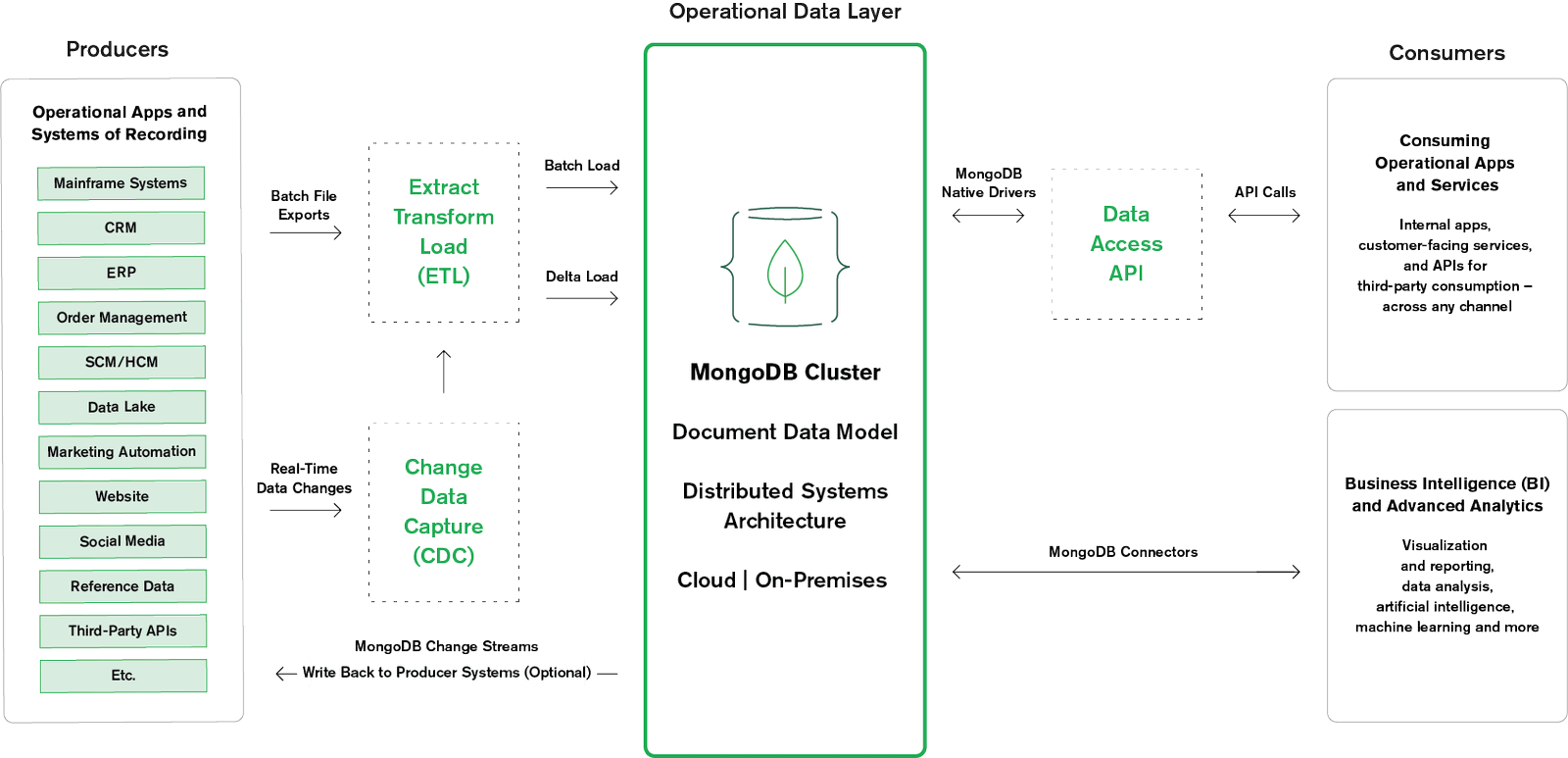
An ODL makes your enterprise data available as a service on demand, simplifying the process of building transformational new applications. It can reduce load on source systems, improve availability, unify data from multiple systems into a single real-time platform, serve as a foundation for re-architecting a monolith into microservices, and more. An Operational Data Layer becomes a system of innovation, allowing an evolutionary approach to legacy modernization.
Data as a Service benefits
Use cases of DaaS
How to build a successful DaaS
Successfully building an ODL and delivering Data as a Service requires a combination of people, process, and technology. Here’s how MongoDB can help.
Data Layer Realization
MongoDB has developed a tried and tested approach to constructing an Operational Data Layer. The Data Layer Realization methodology helps you unlock the value of data stored in silos and legacy systems, driving rapid, iterative integration of data sources for new and consuming applications. Data Layer Realization offers the expert skills of MongoDB’s consulting engineers, but also helps develop your own in-house capabilities, building deep technical expertise and best practices.
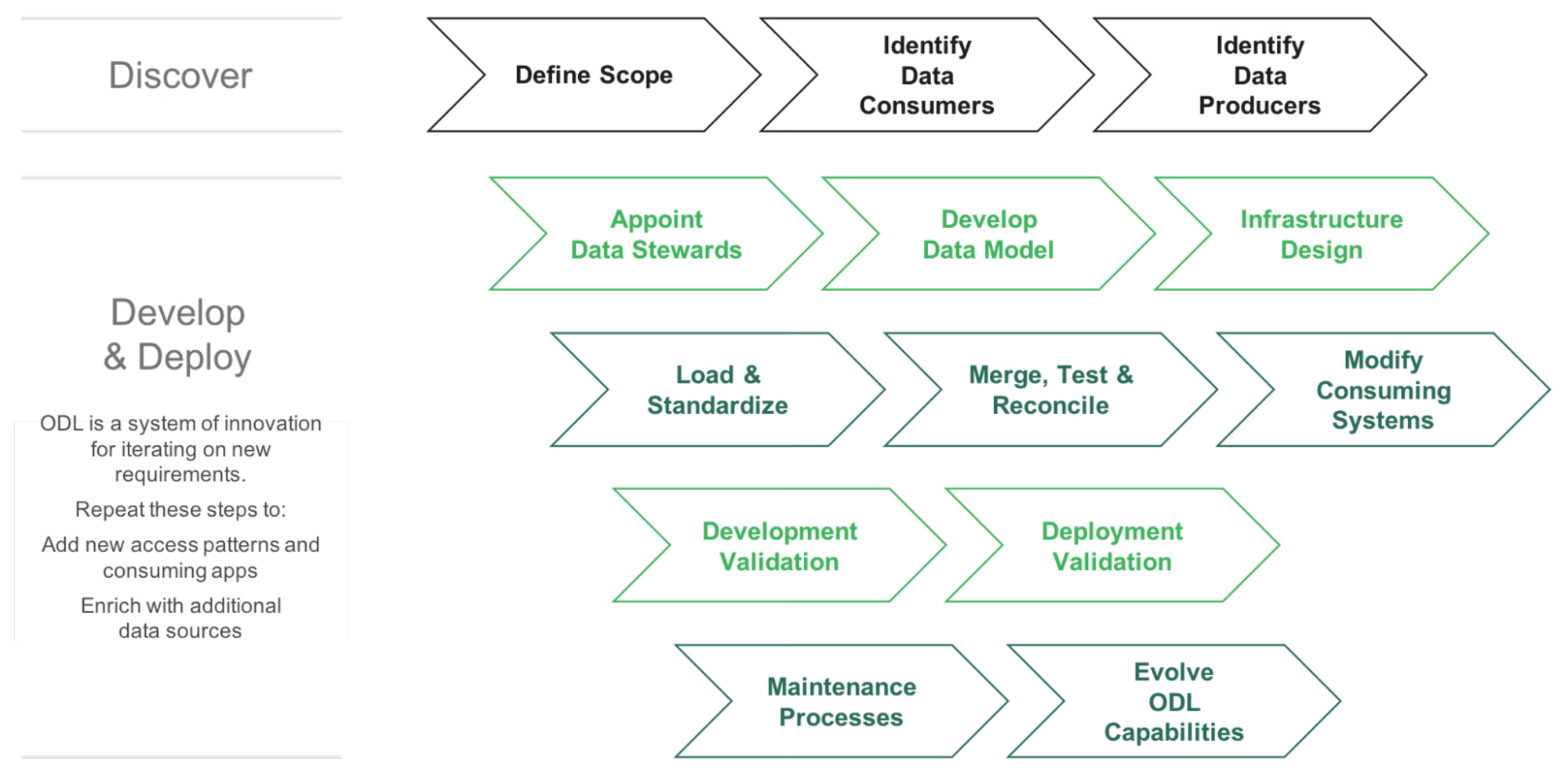
This process for constructing an Operational Data Layer has been successfully implemented with many customers. Starting with clear definitions of project scope and identifying required producing and consuming systems is the first step to ensuring success. Based on these findings, we assign data stewards for clear chains of responsibility, then begin the process of developing and deploying the Operational Data Layer with loading and merging, data access API creation, validation, and optimization. This process is iterative, repeating in order to add new access patterns and consuming apps or enriching the ODL with new data sources.
A successfully implemented ODL is a springboard for agile implementation of new business requirements. MongoDB can help drive continued innovation through a structured program that facilitates prototyping and development of new features and applications.
Why use MongoDB Atlas as a data service?
When you choose MongoDB as the foundation for DaaS, you should definitely use MongoDB Atlas, the Data as a Service platform. MongoDB Atlas is a multi-cloud, cross region platform built on top of MongoDB’s document database. Use Atlas to boost your productivity by letting the platform take care of all the heavy lifting for you.
Advantages of the MongoDB Atlas document model
MongoDB stores data in documents instead of rigid tables. Documents are gathered together in collections. The document model is designed to be flexible and easy to use. Let's take a look at some of the advantages of the MongoDB Atlas document model.
Ease
MongoDB’s document data model is much more natural than the relational tabular model. Documents map to application objects, eliminating the need to use object-relational mappers (ORMs). Additionally, you maintain the same ACID data integrity guarantees you are used to.
Speed
Unifying data in rich MongoDB documents means you can get all the data you need with a single query. You end up writing less code, while your users get better performance when using your application.
Benefits of running your database in the cloud
MongoDB Atlas allows you to store your data in the cloud. But that’s not something very special, is it? What you should care about instead is how Atlas allows you to manage your data.
Availability
MongoDB Atlas has built-in redundancy and self-healing recovery that ensure the resilience of your apps. You don’t need expensive and complex clustering add-ons to add new geographic regions, or configure the replication options for each node.
Scalability
One of the core traits of MongoDB is the scale-out architecture, allowing you to meet growing data volumes and user loads with ease. With MongoDB Atlas, you can choose to deploy a serverless instance that scales as demand increases and charges you only for the used resources and executed database operations.
Workload isolation
Run operational apps while also serving analytics, machine learning, and BI to unlock critical insights in real time. You can use analytics nodes to isolate queries from your operational workload. This allows you to run expensive data analysis without slowing down your application, while you also don’t need to move the data to a separate analytics platform.
Data locality
Data residency laws require a nation's citizens' data to be collected and stored in the boundaries of the same country. Atlas allows you to meet such regulatory compliance mandates with its multi-cloud and multi-region features. For example, if your business starts to operate in Germany, you can provision a new cluster in the Frankfurt region to ensure the data collected in the country stays there.
Avoid vendor lock-in
When the cost of moving to a new vendor is too high, you are locked to that provider. It’s especially difficult to move a live database running in a cloud environment. MongoDB Atlas lets you enjoy the benefits of running your database in the cloud without locking you to a single vendor.
Global multi-cloud coverage
MongoDB Atlas is the only globally distributed, multi-cloud database. You can create multi-cloud MongoDB deployments in Atlas using any combination of cloud providers: Google Cloud, AWS, and Azure. In your multi-cloud deployment, you can query data from an application running in one cloud, and analyze that data on another cloud. And you don’t have to move the data manually!
Portability
MongoDB runs the same everywhere—commodity hardware on-premises, on the mainframe, in the cloud, or as an on-demand, fully managed Database as a Service. You can migrate your cloud database to an on-premises solution without disrupting your process.
MongoDB enables data access and APIs
Consuming systems require powerful and secure access methods to the data in the ODL. MongoDB’s drivers provide access to a MongoDB-based ODL from the language of your choice. Data as a Service reaches its fullest potential when you present a common Data API for applications; this layer can be custom built, using Atlas Data API, or Atlas App Services can be used to expose access methods with a built-in rules engine for fine-grained security policies.
Data as a Service should also be available for analytics. The Connector for Business Intelligence allows analysts to connect to a MongoDB ODL with their BI and visualization tools of choice, or MongoDB Charts can connect directly to the ODL for native visualization. The Connector for Apache Spark exposes MongoDB data for use by all of Spark’s libraries, enabling advanced analytics such as machine learning processes. Finally, multiple data sources can be consumed via the Atlas Data Lake. Atlas data lets you directly query Atlas databases and AWS S3 together using a single API. Furthermore, data lakes can be linked to Charts or Atlas App Services Services.
The future of Data as a Service
Companies understand that data and data services are the heart of the organization and key to its success. Together with the cloud-first adoption, Data as a Service has a bright future. Building and managing data systems in a legacy fashion adds a tremendous overhead to any organization’s IT efforts. Unlocking the innovation of your products with a platform like MongoDB Atlas, leaving behind all the heavy lifting of managing, upgrading and maintaining those stack components, allows companies to deliver faster and better.
Data as a Service will surely evolve in the next few years to open the potential of the digital worlds that surround us and will continue to improve the user experience and help you surpass your customers' wildest expectations.
A natural evolution to DaaS are Database as a Service (DBaaS) platforms. DBaaS platforms offer a complete database solution in the cloud. Data services (DaaS), such as analytics and AI, are provided for the data stored in the cloud database (DBaaS).
MongoDB Atlas, MongoDB’s Database as a Service, is the only multi-cloud, cross region platform built on top of MongoDB’s document database. Over 25,000 customers use MongoDB Atlas to innovate and build the applications of tomorrow. Get started today by creating your forever-free cluster!
Successful Data as a Service adoption

HSBC’s data assets are growing rapidly — from 56 PB in 2014 to 93 PB in 2017. Customers are demanding more, regulators are asking for more, and the business is generating more. In order to make trading data available to a multitude of new digital services, HSBC implemented an Operational Data Layer to become the single source of truth. The ODL, powered by MongoDB, enables HSBC’s development and architecture teams to meet the board’s strategy of using technology to make the bank “simpler, faster, and better.”
Learn more

Alight Solutions (formerly part of Aon PLC) provides outsourced benefits administration for close to 40 million employees from over 1,400 organizations, but retrieving customer data from multiple frontend and backend source systems meant high mainframe MIPS costs, scaling difficulties, and high query latency. Moving to Data as a Service delivered from an ODL on MongoDB reduced query latency by 250x for better customer experience, lowered peak mainframe consumption to reduce costs, and unlocked new business innovation.
Learn more
HSBC’s data assets are growing rapidly — from 56 PB in 2014 to 93 PB in 2017. Customers are demanding more, regulators are asking for more, and the business is generating more. In order to make trading data available to a multitude of new digital services, HSBC implemented an Operational Data Layer to become the single source of truth. The ODL, powered by MongoDB, enables HSBC’s development and architecture teams to meet the board’s strategy of using technology to make the bank “simpler, faster, and better.”
Learn more
Alight Solutions (formerly part of Aon PLC) provides outsourced benefits administration for close to 40 million employees from over 1,400 organizations, but retrieving customer data from multiple frontend and backend source systems meant high mainframe MIPS costs, scaling difficulties, and high query latency. Moving to Data as a Service delivered from an ODL on MongoDB reduced query latency by 250x for better customer experience, lowered peak mainframe consumption to reduce costs, and unlocked new business innovation.
Learn more

Barclays is solving one of the hardest challenges facing any enterprise: a true 360-degree view of the customer with an ODL that gives all support staff a complete single view of every interaction a customer has had with the bank. This is helping Barclays drive customer interactions to new digital channels and improve the customer experience.
Learn more

MongoDB Atlas allows us to deal with multiple cloud providers while avoiding complexity. With Atlas, it’s just BOOM, and make the move. No need to scramble.
Read More
Featured Resources
FAQ
What is meant by Data as a Service?
The term Data as a Service encompasses both the business model, centered around flexible access to your business data, and the cloud-based tools that enable the data services.
Why is Data as a Service used?
Data as a Service unlocks the potential of your business data. This comes with a set of benefits such as:
- Lowered R&D costs.
- Improved development productivity.
- Improved customer experience.
What is SaaS and DaaS?
SaaS stands for "Software as a Service" whereas DaaS stands for "Data as a Service." Data services are usually offered as SaaS solutions to end users.